






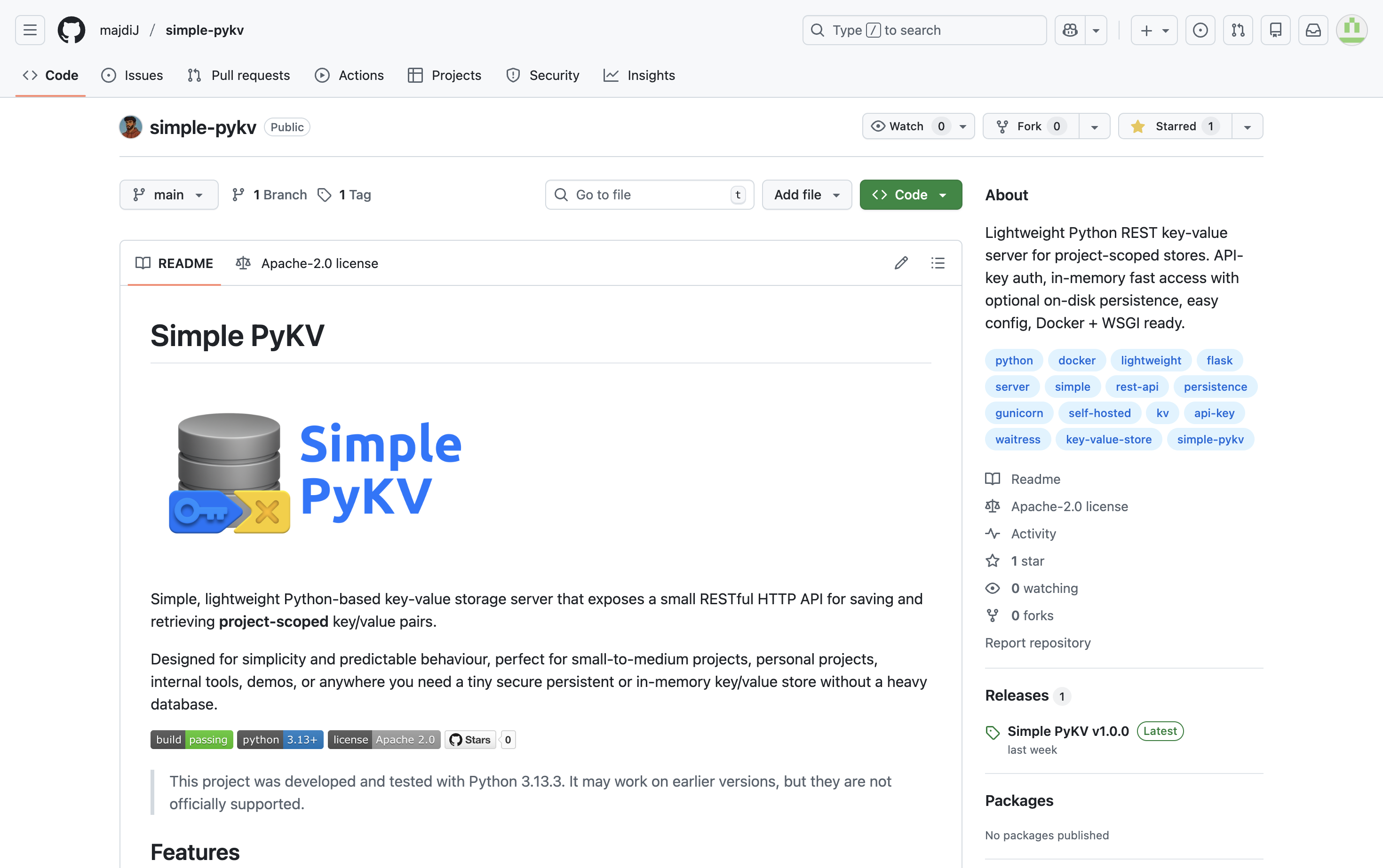
Building Simple-PyKV: A Lightweight Python Key-Value Store server
Adventures in creating an API backend for a simple key-value store using Python
In the computing word, there is no shortage of tools, services, and libraries to help devlopers solve problems. There's a common belif for nearly ever problem a dev may face, there's likey a tool that they can use to help solve it. Often though the tools that are avliable can do the trick, but the don't quite fit the bill.
While I was working on my many diffrent personal projects, prototypes, internal tools, and demos I contnatly ran into the same familiar issue of needing some sort of system where I could centrealy store data that I could CRUD (Create, Read, Update, Delete) across different devices and programs. And the tools that were avliable like common databases felt just a bit too much for these lightweight needs, and I needed a more straightforward and efficient solution.
This recuring pattern of issues made me identify a gap in the toolbox. A need for a lightweight KV storage server that is easy to set up, use, and manage and allowing for CRUD operations on key-value pairs. Thus, Simple-PyKV was made.
In this article, I'll walk through the building of Simple-PyKV.
Table of Contents
The main Point: Why not just use X?
As mentioned, with any issues devlopers face there tends to be some sort of tool to help solev it. So why not just use an existing solution?
My dislike with existing solutions was that they were just too complex and/or overkill for my simple needs. Using full databases (PostgreSQL, MySQL) requires complex setup, schema management, high memory usage, and connection pooling, too much infrastructure for simple KV pair system. Even with NoSQL/caches (Redis, Memcached) , while they're incredibly fast, useful, and scalable, setting them up requires a lot of overhead, APIs can be complex, and can be challenging to manage for small projects.
I also wanted somthing with easy format of data persistence in a human-readable way without special software, which I feel many databse system coudn't provide. I considered file storage/JSON files that would be soley saved on that machine, but that meant no easy way to access the data remotely and could cause data corruption with concurrent access.
Another reason was simply for the opertunity to learn . Building this project of simple key-value store server from scratch is a great way to deepen my understanding of RESTful APIs, data storage, backend development, and programing in Python using OOP principles.
Simple-PyKV is a middle ground, a self contained, easy to deploy service that handles REST API requests, thread-safe storage, and project separation, letting a developer focus purely on storing and retrieving data without the overhead of managing a full database system.
Core Philosophy: Design, simplicity and Control
Curretnly studying Computer Science at university, and doing Object Oriented Programming (OOP) module focusing mainly on Java but also touching on Python. Learning OOP concepts and principles such as encapsulation, modularity, and separation of concerns and applying them in my Java code has influenced how I approached designing Simple-PyKV.
Though when Simple-PyKV was started, I only knew OOP soley in Java, I realised how useful these concepts are across programming languages, including Python. So I learnt how to make use of classes, methods, and attributes in Python to create a clean and maintainable codebase. Later through the module, we startd learning about OOP in Python, which helped me solidify my understanding and use correct Pythonic conventions (which can be seen by me refactoring my code to be more Pythonic, evidenced by my commit history and issues on GitHub).
The code design of Simple-PyKV focuses on simplicity and clarity. Each class, method and attribute has a well defined role — Easy to understand and extend. This modularity allows for easier debugging, testing, and future enhancements.
Every project gets its own distinct, isolated namespace. This is crucial for handeling mulriple projects, multi-environment apps where data for 'App A' should never mix with 'App B'. Each project has its own authentication and storage settings. This isolation ensures data integrity and security across different applications using the same Simple-PyKV server.
Settings are manged by the
config.json
file. When the program starts, it reads this file to load all necessary configurations data like projects, authentication keys, and storage options. This approach makes the server highly configurable without needing to change code and being predictable, easily deployable across different environments and easily adaptable for different needs.
View configuration documentation here.
Projects can choose to be in-memory only (for fast caching/temp data) or on-disk persistent (for configuration or state that must survive a server restart). Both are managed seamlessly by the config file or API calls.
Security by Design: Isolation and Authentication
For any program handling data, security is a important. Especially for any service that exposes an API over the network, stores potentially sensitive data, or is used in multi-tenant environments - all of which apply to Simple-PyKV. Security must be baked into the design from the start.
By defualt the server genorates strong sercure API keyes and by defualt these keys are never stored in plain text but rather hashed using secure hashing algorithms.
There are two levels of API keys in Simple-PyKV: System/Global API Key and Project API Keys. System/Global API Keys are used for managing the server itself - creating/deleting projects, viewing server status, etc. While Project API Keys are scoped to individual projects, allowing CRUD operations on keys/values within that specific project only.
These two levels of API keys follows the security principle of least privileg — important security concept, ensuring that users or systems only have the minimum access necessary to perform their tasks and prevent unauthorized access.
The
project_discoverable
and
keys_and_values_discoverable
settings are significant security measures. They allow an developers to hide the very existence of a project or its keys from an attacker, even if they hold a valid API key, enforcing an extra layer of access control. This follows the security principle of "security through obscurity," which can be effective in reducing the attack surface.
Technical Foundation: Python and REST
There exists a wide range of programming languages and frameworks that can be used to build API servers and KV stores. Python, flask, and RESTful principles were the right choice for Simple-PyKV for several reasons: simplicity, readability, and extensive standard library. The aim of this project was to create a simple , accessible key-value store server, and Python's syntax and ecosystem align well with my goals.
The application uses Flask for the web framework. Crucially, for secure deployment, esspicaly when connected to the internet, using a proper WSGI server like Gunicorn or Waitress over Flask’s built-in server is important, this ensures security, performance, and reliability in production environments.
Though Simple-PyKV is meant for small amount of requests, there still are considerations for concurrency and thread-safety. Requests may try to read, write, update, or delete the same keys at the same time. Without proper safety design, this can lead to data loss/corruption. To handel this, I implemented python thread locking mechanisms around all parts where data is modified, ensuring that only one thread can modify a KV / system at a time. This provides data integrity even with concurrent requests.
Simple-PyKV API routes are designed in a way wich makes their behavior and responses predictable. Following the standar conventions of RESTful APIs, using appropriate HTTP methods such as GET, POST, PUT, DELETE for respective operations. Making it simple and intuitive for developers to integrate with their projects. View detailed API documentation
here in
routes.md
.
Project Scope and Utility
Simple-PyKV isn't designed to replace full-fledged databases or key-value stores like Redis or DynamoDB. Instead, it's meant to fill a niche for lightweight, easy-to-deploy key-value storage for small projects, prototypes, or internal tools where simplicity and ease of use are more important than advanced features or scalability.
| Feature | Description |
|---|---|
| Lightweight | Minimal dependencies and designed for small-to-medium or personal projects. |
| Python-based | Written in Python: easy to understand and extend to fit personal needs. |
| RESTful API | Exposes a small predictable HTTP API routes for server management and key/value operations. |
| Project-scoped stores | Isolated namespaces per project (multi-project support). |
| API key authentication | Simple API-key auth (system-level and per-project keys). |
| Multiple auth headers |
Supports different ways to take API keys (
Authorization
,
X-API-Key
,
Api-Key
) in requests.
|
| CRUD operations | Simple create, read, update, and delete for keys and values. |
| In-memory & optional on-disk persistence | Use fast in-memory access with ability to persist data to disk for durability (optional per project). |
| Small config |
Single
config.json
configuration file with appropriate and secure defaults.
|
| Metadata support | Each key stores metadata (timestamps, size, type) with ability to access the metadata + value, or solely the value. |
| Key/value & project discovery controls | Security controls to allow all projects to be discoverable or restrict visibility as needed along with project key/value discovery options. |
| Thread-safe | Designed for safe concurrent API access. |
| waitress/gunicorn/docker support | Recommended for production with Gunicorn/Waitress; includes Dockerfile and docker-compose guide. |
| Simple logging / CUI | Terminal logging / console UI available for basic monitoring. |
| Routes docs |
Detailed API routes documented in
routes.md
file with examples, explanations, support and code samples.
|
What’s Next for Simple PyKV
Simple-PyKV is a small challenge project I built during my otherwise busy university and life schedule, so I don't have immediate plans for major new features. Simple-PyKV is out of beta and as of December 2025, it's latest version is 1.0.0 has been released. Which means it's stable and ready for production use.
However, I do want to continue improving its stability, performance, and documentation over time and welcome contributions. Some potential areas for future exploration include:
-
Advanced Data Types
Currently, it handles JSON and raw text, but adding explicit support for more complex structured data types might simplify client-side parsing. -
Replication and Backup
Implementing optional data replication or backup features to enhance data durability and recovery options via simple API calls or routine snapshots. -
Further dara validation and constraints
Adding support for data validation rules or constraints (e.g., max size, allowed patterns) for keys and values to prevent invalid data storage and for config file options. -
More Logging Control
Fine-tuning the CUI/logging system to give developers more control over verbosity and log output formats. -
Enhanced Testing
As of now, there is no testing implemented. Adding a comprehensive testing code would improve reliability and facilitate future changes, especially as new features are added by contributors.
Simple PyKV is a direct result of my own need for a lean, secure, and easily manageable storage solution. It's a testament to choosing the right tool for the job, even if that tool needs to be built from scratch. Showing the power of programming to solve real problems in a practical way.
See the Code
Simple-PyKV is licensed under the Apache License 2.0. See the LICENSE file for details. Click above link for the full license text.
Note:
Trademarks and logos are not included in the license.